Trigonometry
Trigonometric equation and graphing (Test)
- angles in standard position
- the arrows in initial and terminal arms are optional
- rotation angles (greater than 360
) would need extra swirls when sketching
- coterminal, reference (positive acute angle), quadrantal angles:
, - Coterminal angles - angles in standard positions (if the vertex of the angle is at the origin of the x-y plane and its initial arm lies along the positive x-axis) with the same terminal arm
- Positive angle sketched counterclockwise, negative sketched clockwise
- Principal angle (0,
) - smallest positive coterminal angle - Reference angle (0,
) - positive acute angle formed with the terminal arm of and the x-axis - Quadrantal angle - any angle whose terminal arm is on either the x- or y-axis
- evaluating trig ratios and finding unknown angles
- Primary trigonometric ratio
- SOH:
= opposite/hypotenuse = 1/
- CAH:
= adjacent/hypotenuse = 1/
- TOA:
= opposite/adjacent = 1/
- SOH:
- when calculating the ratios
- put the negative signs in front of the entire fraction
- keep the x, y, r, all positive when calculating the reference angles, and then later add the negative sign in brackets if needed
- if using the scientific calculator, make sure the calculator is in the degree mode and align the manual calculation
- beware of the range of
in the question or if it's a general solution, in radian or degree etc. - beware of the domain of
it's not necessarily [0, ) - ex.
= 0.642 - - note radian/degree units in the final answer
- CAST system: acronym denoting which quadrants the ratios among sin, cos, tan are are (is) positive, in the order of Quadrant 4,1,2,3
- Primary trigonometric ratio
- arc length (a=r
in radians) sector area (A= in radians) - graphing
- all roots on the graph: the x-coordinates of all x-int points, note to only add the ones on the graph
- Desmos graphing online can be used to check the shape
- Amplitude cannot be negative =
= |a| - Vertical displacement =
- special name for the vertical translation of a sinusoidal function - Phase shift - special name for the horizontal translation of a sinusoidal function; + right, - left
- Shift & displacement both needed to be conducted at the last as in function translation when graphing
- problem solving
- if not marked specifically, 1 unit on the square means 1
- Sinusoidal function graphing, don't come up too steep
- read the question clearly, like number of periods etc. requirement for sketching
- include a conclusion statement
- only round in the final answer
- when converting, don't forget to add the
- beware of the Calculator mode: degree - radian
in radian = in degree
Identities (Test)
- Test: Monday 04.17
- Proofs (2)
- Simplifying (1)
- Solving (2)
- Find an exact value of a trig ratio (2)
- reciprocal trig ratios:
- quotient identities
- Pythagorean identities
- addition identities
- Strategies to simplify a trig expression
- get a common denominator
- factor
- change terms to sine or cosine
- multiply the numeral and denominator both with a conjugate binomial
conjugate binominal would be
- double angle
- when combining restrictions, beware not to miss any sub-restrictions by testing with a full rotation
- when proving identities, start simplifying with the side identified to be more complicated
- LCD = lowest common denominator
- QED = Latin, meaning which was to be demonstrated
- double cross for fractions equations
Others
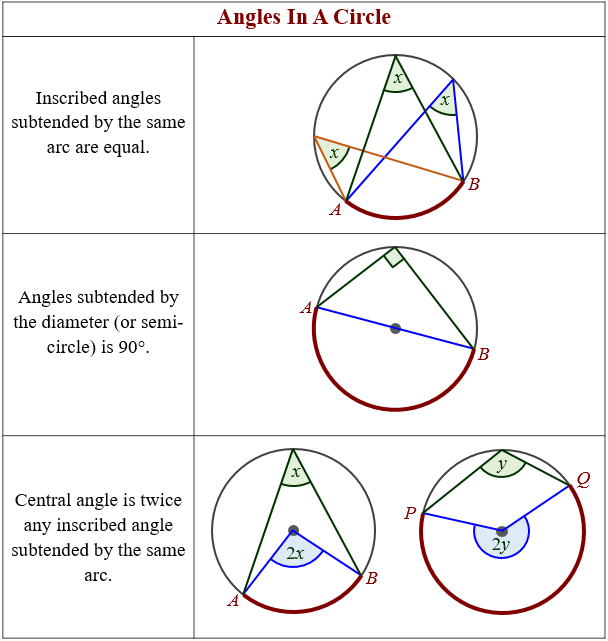
- Angles in a Circle
- Central angle is twice any inscribed angle subtended by the same arc
- Inscribed angles subtended by the same arc are equal - angles in the same segment theorem: angles in the same segment are equal
- Angles subtended by the diameter is
- Cyclic quadrilateral: the opposite angles in a cycle
- Use height of the triangle to prove
- Law of sines:
- R is the radius of the triangle's circumcircle
- Law of cosines:
- Others
- angular measure
- trigonometric ratio
- solving trigonometric equations
- algebraic method using calculator
- ambiguous case (SSA)